ATT × Daikin
Restricted partner content
This page is restricted to authorised contacts. Please enter your access code or contact us to request access.
ATT × Daikin
Where thermal engineering meets climate innovation — a look at the technology areas where ATT and Daikin are building the future of heating, cooling, and sensing together.
Shared territory:
sensor technology, advanced materials, thermal & energy
Daikin's Technology and Innovation Center (TIC) explicitly names three areas where external technology partners are being sought: sensor technology, advanced materials and processing technology, and thermal & energy technology. This is ATT's exact home turf.
ATT's portfolio of printed PTC heating foils, capacitive frost sensors, and flexible temperature sensor arrays addresses Daikin's most pressing engineering challenges — from the #1 heat pump problem (defrost in winter) to smart cold chain monitoring and indoor condensation prevention.
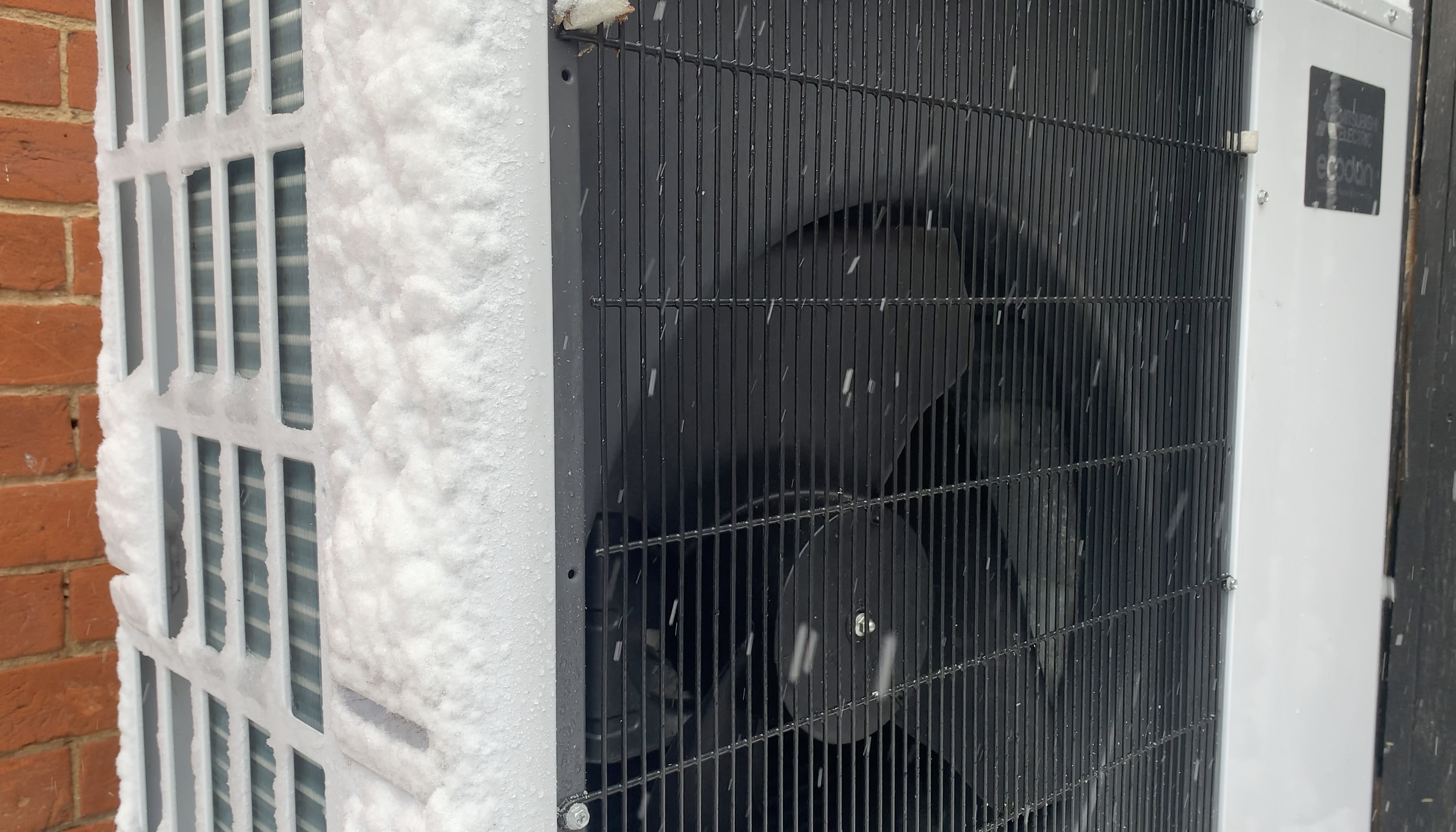
Heat pump outdoor unit operating in sub-zero winter conditions — frost accumulation on the heat exchanger is Daikin's stated #1 challenge in cold-climate markets.
Smarter Defrost for Heat Pumps
Detection + prevention — ATT addresses both sides of the frost problem with a single technology platform.
Demand-Controlled Defrost via Capacitive Frost Sensing
Daikin's TIC explicitly identifies frost as the "biggest challenge in replacing combustion heating with heat pump heating." Current defrost cycles run on fixed timers or temperature thresholds — crude approximations that waste energy, interrupt heating comfort, and stress the refrigerant circuit.
ATT's capacitive frost sensors detect frost formation directly on the heat exchanger fin surfaces in real time — before it has accumulated enough to impair airflow. Combined with ATT's printed flat temperature sensor arrays, the system maps exactly where frost starts to form, enabling the controller to trigger defrost only when and where it is genuinely needed.
- → Demand-controlled defrost reduces cycle frequency by 20–40%
- → No more comfort gaps — heating is not interrupted unnecessarily
- → Direct contribution to ErP efficiency class and SCOP ratings
- → Spatial frost map feeds Daikin's AI fault-monitoring platform
Electrothermal Anti-Frosting for Outdoor Heat Exchangers
Where sensing tells the system that frost is forming, PTC heating foils can prevent it at the source. ATT's flexible PTC heating foils can be integrated directly into or laminated onto outdoor heat exchanger frame areas, header sections, and fin inlet edges — precisely the zones where frost nucleation begins.
The key advantage of PTC technology here is its intrinsic self-regulation: the foil physically cannot overheat the aluminum structure it is bonded to. This eliminates the need for active temperature control electronics, simplifies installation, and preserves the structural integrity of Daikin's proprietary microchannel heat exchanger geometry.
- → Operates in parallel with refrigerant circuit — no heating interruption
- → PTC self-regulation: intrinsically safe for aluminum HX surfaces
- → Combined with capacitive sensor (Topic 1) → fully demand-driven activation
- → Direct fit for Daikin Altherma cold-climate variants
Combined value: ATT is one of the very few partners that can address both the sensing and the actuation side of the frost problem — an end-to-end solution from a single supplier.

Condensation Prevention on Indoor Units
In humid climates — Southeast Asia, Japan, the Middle East — condensation dripping from indoor AC units is a persistent and serious quality complaint. When an indoor unit transitions between operating states (start-up, partial load, shutdown), surface temperatures on louvers, drip trays, and housing edges can briefly fall below the local dew point. The result: visible dripping, mold risk inside the ducting, and perceived product failure.
ATT's approach combines a dew point controller (calculating the risk threshold from ambient temperature and humidity) with thin-film temperature sensors on critical surfaces and a surface heating foil that keeps those surfaces marginally above the dew point during transition phases. The system is invisible, silent, adds minimal power, and can be fully integrated into Daikin's existing controller platform.
Expanding the Collaboration
Two additional high-fit areas where ATT technology creates measurable value across Daikin's product portfolio.
Spatial Temperature Sensing in Cold Chain & Refrigeration
Daikin's TIC Cold Solution research explicitly focuses on food freshness and temperature homogeneity. Commercial refrigeration — whether supermarket display cases, cold storage rooms, or transport units — has one persistent problem: single-point temperature sensors give misleading averages that can mask warm pockets where food spoils faster or cold zones that waste energy.
ATT's printed flexible temperature sensor arrays mount directly on evaporator surfaces, shelf liners, or cold room walls as thin-film area sensors that map the actual spatial temperature field. This enables per-zone energy optimization, food safety documentation for regulatory compliance, and early fault detection — feeding directly into Daikin's AI-based equipment monitoring strategy.
- → Spatial mapping vs. single-point measurement: detect cold spots before they cause failures
- → Richer data input for Daikin's AI fault monitoring platform
- → Printable / laminatable — integrates into Daikin manufacturing, not field retrofits
Pipe & Valve Freeze Protection for Cold-Climate Heat Pumps
Daikin's Fusion 25 strategy makes cold-climate heat pump expansion — Scandinavia, Alpine Europe, Canada, Northeast US, Japanese mountain regions — a top commercial priority. In extreme cold, refrigerant piping connections, expansion valves, and outdoor unit drain lines are at risk of freezing during extended cold snaps. A single blocked drain or frozen expansion valve can cause a service call or claim.
ATT's flexible self-regulating PTC heating foils conform to pipes, valve bodies, and drain line geometry without rigid mounting hardware. The PTC material activates automatically when surface temperature approaches the critical threshold and self-limits power when the component is warm — entirely without thermostats, controllers, or wiring complexity.
- → Self-activating, self-limiting — no external controller required
- → Flexible flat form factor: wraps pipes, valves, drain lines in any geometry
- → Direct product improvement for Daikin Altherma cold-climate variants
- → Negligible standby power — only draws energy when genuinely needed
Additional Collaboration Areas
Drain Pan Heating for Commercial Refrigeration
Keeping drain pans ice-free under evaporators in commercial display cases and cold rooms is a mandatory requirement — currently solved with resistive wire heaters that are imprecise and difficult to service. ATT's custom-shaped PTC foils conform to any drain pan geometry, are integrable at OEM manufacturing level, and self-regulate without any risk of overheating the plastic pan. A clear path from after-market service item to designed-in OEM component.
IAQ Spatial Sensing: The Room as a Sensor
Daikin's "Creation of Air Value" strategy targets specialized sensing that goes beyond comfort temperature and humidity. ATT's printed flexible sensor foils mounted on room surfaces — walls, ceilings, supply air grilles — act as a distributed sensing layer: mapping temperature stratification, detecting drafts, and identifying local condensation risk in real time. This gives Daikin's room controllers and BMS systems far richer data than any single-point sensor can provide, and aligns directly with their declared Open Innovation priority of "sensor technology" and "advanced materials."
Dew Point Controller as Embedded BMS Module
Across all HVAC applications, dew point is never directly measured — it is calculated from temperature and humidity, and the quality of that calculation determines whether condensation protection, ventilation control, and humidity management work correctly. ATT can offer an embedded dew point controller module as a component collaboration: a licensed algorithm plus hardware block that integrates into Daikin's BMS "semi-customization" platform (as named in their TIC 2026 strategy). Precise, validated, and designed for seamless OEM integration.
One partner. Both sides of the thermal equation.
Most technology suppliers can address either the sensing side or the heating actuation side of a thermal management problem. ATT is one of the very few companies with deep expertise on both — and the ability to develop, prototype, qualify, and manufacture from a single source.
For Daikin, this means fewer integration interfaces, faster development cycles, and a partner who can follow a project from the first feasibility sketch all the way to series supply — all within a single ISO 9001‑certified manufacturing environment in Austria.
Let's Start Your Project
Ready for the next generation of thermal solutions? Contact our expert team.
Response within 24 hours • Free initial consultation