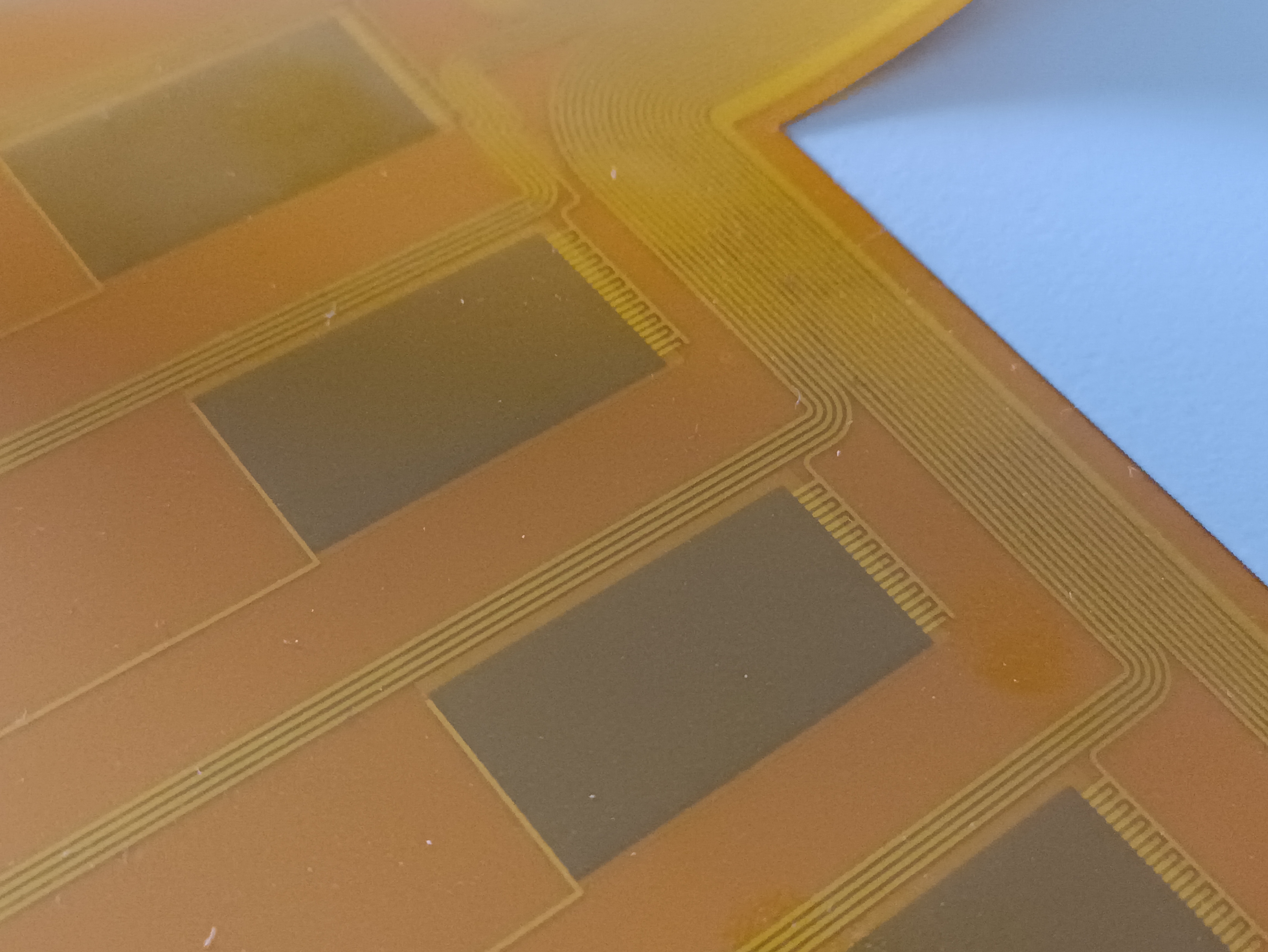
A single temperature sensor can confirm one location. It cannot always explain how a surface warms up, where hotspots form or how gradients move during load changes.
Printed NTC strips and arrays can be designed close to the physical surface. This makes them useful for development teams that need thermal validation data before final heater layouts, control logic or package decisions are frozen.
When printed arrays add value
Mapping a temperature field
Multiple printed sensing points can reveal gradients that a single packaged sensor misses.
Finding hotspots
Sensor geometry can be placed near risk zones, edges, contacts or heater transitions.
Comparing heater layouts
Array data helps evaluate whether a pattern heats the intended area uniformly enough.
Supporting control concepts
Validation can show which sensor location best represents the functional surface.
Comparison
| Decision point | Engineering focus | Why it matters |
|---|---|---|
| Single SMD NTC | Simple reference point | Limited view of gradients and local peaks |
| Printed strip sensor | Line-based measurement along a critical path | Useful near edges, seams or heat flow directions |
| Printed array | Multiple distributed measurement zones | Best for mapping surfaces and comparing layouts |
| Thermal camera | Non-contact full-field view | Strong for lab visualization, less suited as integrated sensing concept |
Common engineering questions
What are printed NTC sensor arrays?
Printed NTC sensor arrays are distributed temperature-sensing structures printed on or near a surface. They can be designed as multiple points, strips or zones to measure temperature fields rather than only one location.
When are printed sensor arrays useful for heater validation?
They are useful when a development team needs to understand gradients, local peaks, transient behavior or differences between heater layouts before a design is frozen.
How can printed sensors help detect hotspots?
A printed sensor layout can place measurement points near expected risk zones such as edges, contacts, seams or heater transitions, making local peaks easier to identify.
What is the difference between a single NTC and a printed sensor array?
A single NTC provides one reference point. A printed array can show how temperature varies across a line or surface and can reveal gradients that one point cannot explain.
How do printed sensor arrays support thermal validation?
They connect measurement geometry with the heater layout, surface stack and control concept, helping validation answer the engineering question instead of only reporting one temperature value.
Engineering takeaway
Thermal validation should answer the design question, not only produce a temperature value. Printed sensor arrays can connect measurement geometry with the heater layout, surface stack and control concept.