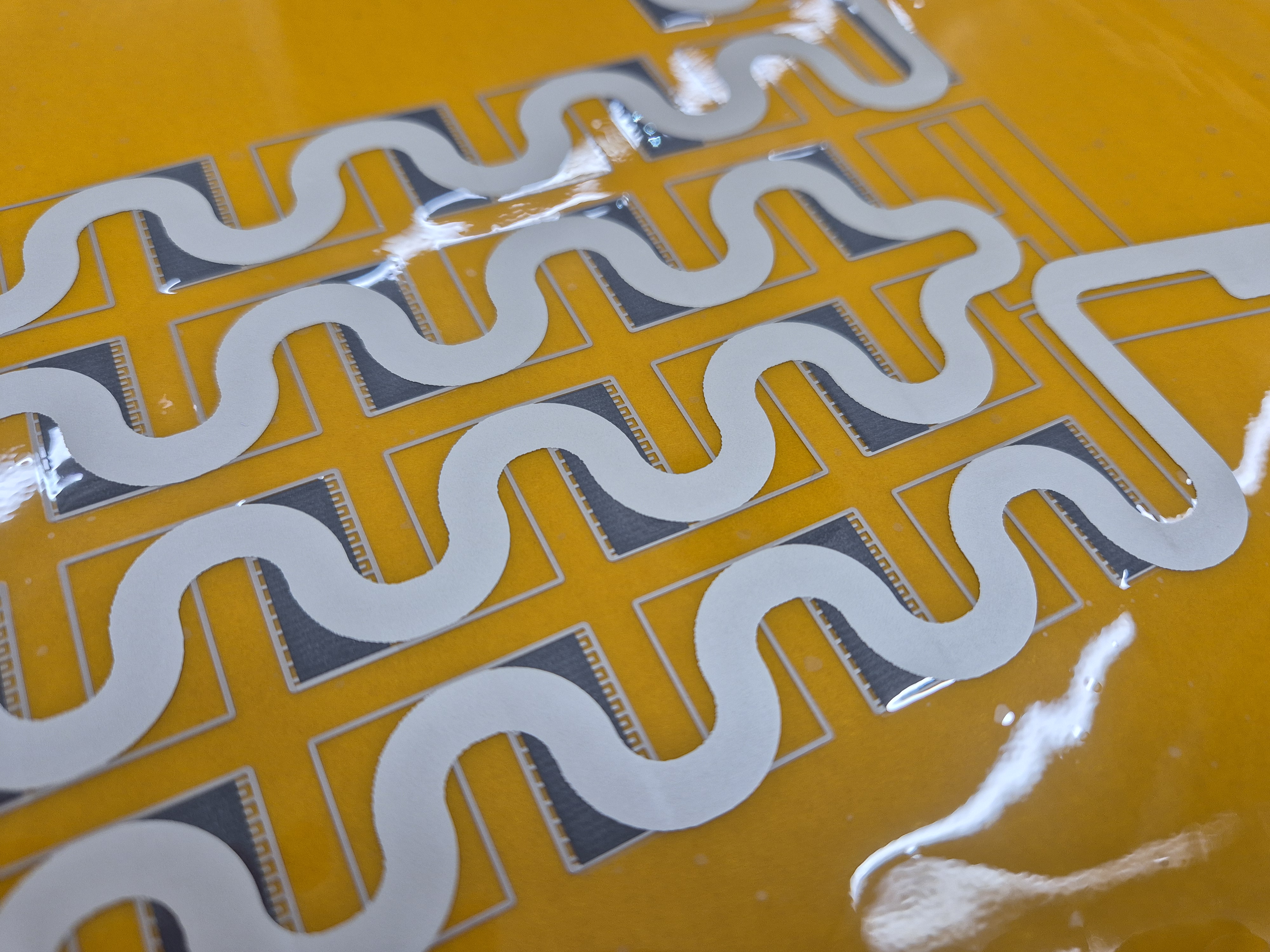
Engineers often search for a printed temperature sensor, a temperature sensor on foil or a thin NTC sensor when the measurement point is difficult to reach with a conventional packaged component. The challenge is not simply measuring temperature. It is measuring temperature close to a surface, inside a thin stack, near a heater pattern or across a functional area without adding unnecessary height or mechanical complexity.
ATT's Printable NTC Sensor concept uses a screen-printed resistive layer based on ceramic NTC particles. Depending on the stack-up, it can be designed as a point sensor, strip, array or hotspot-sensitive geometry. This makes it relevant for thermal validation, surface measurement and integrated control concepts where a standard SMD NTC is mechanically or thermally not ideal.
Where printed NTC sensing helps
Thin material stacks
When component height matters, a printed layer on foil can place temperature measurement closer to the physical interface.
Thermal validation
Arrays or strips can help development teams understand temperature fields, hotspots and transient behavior during tests.
Heated functional surfaces
Printed sensors can be designed near heating structures to support feedback, monitoring or characterization of surface behavior.
Battery and module development
Thin sensing concepts can be evaluated where installation space, pressure changes and thermal gradients must be considered together.
Comparison
| Decision point | Engineering focus | Why it matters |
|---|---|---|
| Installation height | Very thin layer possible in a designed stack-up | Requires packaged component height and placement area |
| Measurement geometry | Point, strip, array or area-sensitive layouts | Usually one discrete measurement point |
| Integration effort | Needs application-specific layout, substrate and protection concept | Standardized component, simple when space and assembly fit |
| Best use case | Surfaces, thin stacks, validation, hotspots, integrated foils | PCB or assembly locations where a package is acceptable |
Engineering takeaway
The best solution is application-specific. ATT combines printed heater and sensor know-how with layout, substrate and process evaluation so the functional layer fits the real engineering constraint.